Text-to-Speech Singlish
Text to Melspectrogram using Tacotron2 and FastSpeech2, trained on Singapore National Speech Corpus, https://www.imda.gov.sg/programme-listing/digital-services-lab/national-speech-corpus
This tutorial is available as an IPython notebook at malaya-speech/example/tts-singlish.
This module is not language independent, so it not save to use on different languages. Pretrained models trained on hyperlocal languages.
This is an application of malaya-speech Pipeline, read more about malaya-speech Pipeline at malaya-speech/example/pipeline.
[1]:
import malaya_speech
import numpy as np
from malaya_speech import Pipeline
import matplotlib.pyplot as plt
import IPython.display as ipd
Tacotron2 description
Malaya-speech Tacotron2 will generate melspectrogram with feature size 80.
Use Malaya-speech vocoder to convert melspectrogram to waveform.
FastSpeech2 description
Malaya-speech FastSpeech2 will generate melspectrogram with feature size 80.
Use Malaya-speech vocoder to convert melspectrogram to waveform.
Cannot generate more than melspectrogram longer than 2000 timestamp, it will throw an error. Make sure the texts are not too long.
GlowTTS description
Malaya-speech GlowTTS will generate melspectrogram with feature size 80.
Use Malaya-speech vocoder to convert melspectrogram to waveform.
List available Tacotron2
[2]:
malaya_speech.tts.available_tacotron2()
[2]:
| Size (MB) | Quantized Size (MB) | Combined loss | Understand punctuation | Is lowercase | |
|---|---|---|---|---|---|
| male | 104 | 26.3 | 0.1838 | True | True |
| female | 104 | 26.3 | 0.1887 | True | True |
| husein | 104 | 26.3 | 0.1165 | True | True |
| haqkiem | 104 | 26.3 | 0.1375 | True | True |
| female-singlish | 104 | 26.3 | 0.0923 | True | True |
| yasmin | 104 | 26.3 | 0.06874 | True | False |
| osman | 104 | 26.3 | 0.06911 | True | False |
List available FastSpeech2
[3]:
malaya_speech.tts.available_fastspeech2()
[3]:
| Size (MB) | Quantized Size (MB) | Combined loss | Understand punctuation | Is lowercase | |
|---|---|---|---|---|---|
| male | 125 | 31.7 | 1.8 | True | True |
| female | 125 | 31.7 | 1.932 | True | True |
| husein | 125 | 31.7 | 0.5832 | True | True |
| haqkiem | 125 | 31.7 | 0.5663 | True | True |
| female-singlish | 125 | 31.7 | 0.5112 | True | True |
| yasmin | 125 | 31.7 | 0.7212 | True | False |
| yasmin-small | 32.9 | 8.5 | 0.7994 | True | False |
| osman | 125 | 31.7 | 0.7341 | True | False |
| osman-small | 32.9 | 8.5 | 0.8182 | True | False |
List available GlowTTS
[4]:
malaya_speech.tts.available_glowtts()
[4]:
| Size (MB) | Quantized Size (MB) | Combined loss | Understand punctuation | Is lowercase | |
|---|---|---|---|---|---|
| male | 119 | 27.6 | -1.429 | True | True |
| female | 119 | 27.6 | -1.464 | True | True |
| haqkiem | 119 | 27.6 | -1.649 | True | True |
| female-singlish | 119 | 27.6 | -1.728 | True | True |
| yasmin | 119 | 27.6 | -1.908 | True | False |
| osman | 119 | 27.6 | -1.908 | True | False |
| multispeaker | 404 | 79.9 | -1.882 | True | True |
Load Tacotron2 model
Read more about Tacotron2 model at https://malaya-speech.readthedocs.io/en/latest/tts-tacotron2-model.html
[5]:
tacotron = malaya_speech.tts.tacotron2(model = 'female-singlish')
quantized_tacotron = malaya_speech.tts.tacotron2(model = 'female-singlish', quantized = True)
Load quantized model will cause accuracy drop.
Load FastSpeech2 model
Read more about FastSpeech2 model at https://malaya-speech.readthedocs.io/en/latest/tts-fastspeech2-model.html
[14]:
fastspeech = malaya_speech.tts.fastspeech2(model = 'female-singlish')
quantized_fastspeech = malaya_speech.tts.fastspeech2(model = 'female-singlish', quantized = True)
Load GlowTTS model
Read more about GlowTTS model at https://malaya-speech.readthedocs.io/en/latest/tts-glowtts-model.html
[15]:
glowtts = malaya_speech.tts.glowtts(model = 'female-singlish')
quantized_glowtts = malaya_speech.tts.glowtts(model = 'female-singlish', quantized = True)
Predict Tacotron2
def predict(self, string):
    """
    Change string to Mel.

    Parameters
    ----------
    string: str

    Returns
    -------
    result: Dict[string, decoder-output, mel-output, universal-output, alignment]
    """
It only able to predict 1 text for single feed-forward.
[8]:
string1 = 'PETALING JAYA: Former prime minister Najib Razak has criticised the Inland Revenue Board’s (LHDN) move to serve him a bankruptcy notice, which his legal team had earlier called a political ploy.'
[16]:
%%time

r = tacotron.predict(string1)
CPU times: user 3.3 s, sys: 148 ms, total: 3.45 s
Wall time: 2.66 s
[17]:
%%time

quantized_r = quantized_tacotron.predict(string1)
CPU times: user 3.46 s, sys: 156 ms, total: 3.61 s
Wall time: 3.33 s
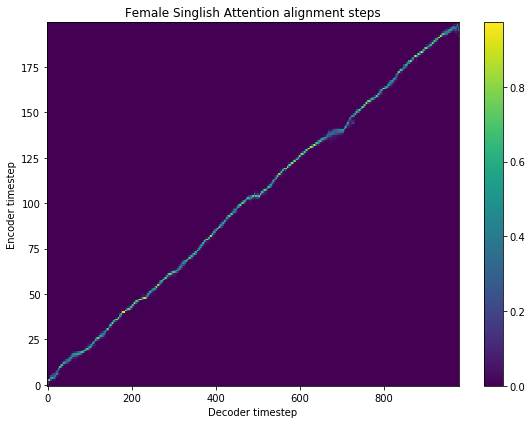
[18]:
fig = plt.figure(figsize = (8, 6))
ax = fig.add_subplot(111)
ax.set_title('Female Singlish Attention alignment steps')
im = ax.imshow(
    r['alignment'],
    aspect='auto',
    origin='lower',
    interpolation='none')
fig.colorbar(im, ax=ax)
xlabel = 'Decoder timestep'
plt.xlabel(xlabel)
plt.ylabel('Encoder timestep')
plt.tight_layout()
plt.show()
[19]:
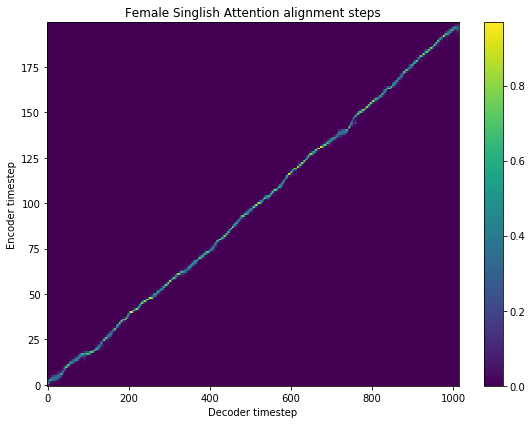
fig = plt.figure(figsize = (8, 6))
ax = fig.add_subplot(111)
ax.set_title('Female Singlish Attention alignment steps')
im = ax.imshow(
    quantized_r['alignment'],
    aspect='auto',
    origin='lower',
    interpolation='none')
fig.colorbar(im, ax=ax)
xlabel = 'Decoder timestep'
plt.xlabel(xlabel)
plt.ylabel('Encoder timestep')
plt.tight_layout()
plt.show()
[20]:
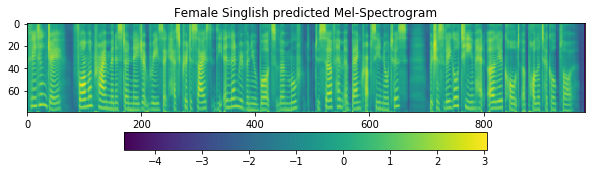
fig = plt.figure(figsize=(10, 8))
ax1 = fig.add_subplot(311)
ax1.set_title('Female Singlish predicted Mel-Spectrogram')
im = ax1.imshow(np.rot90(r['mel-output']), aspect='auto', interpolation='none')
fig.colorbar(mappable=im, shrink=0.65, orientation='horizontal', ax=ax1)
plt.show()
[21]:
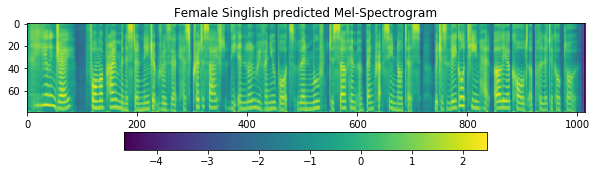
fig = plt.figure(figsize=(10, 8))
ax1 = fig.add_subplot(311)
ax1.set_title('Female Singlish predicted Mel-Spectrogram')
im = ax1.imshow(np.rot90(quantized_r['mel-output']), aspect='auto', interpolation='none')
fig.colorbar(mappable=im, shrink=0.65, orientation='horizontal', ax=ax1)
plt.show()
Predict FastSpeech2
def predict(
    self,
    string,
    speed_ratio: float = 1.0,
    f0_ratio: float = 1.0,
    energy_ratio: float = 1.0,
):
    """
    Change string to Mel.

    Parameters
    ----------
    string: str
    speed_ratio: float, optional (default=1.0)
        Increase this variable will increase time voice generated.
    f0_ratio: float, optional (default=1.0)
        Increase this variable will increase frequency, low frequency will generate more deeper voice.
    energy_ratio: float, optional (default=1.0)
        Increase this variable will increase loudness.

    Returns
    -------
    result: Dict[string, decoder-output, universal-output, mel-output]
    """
It only able to predict 1 text for single feed-forward.
[22]:
%%time

r_fastspeech = fastspeech.predict(string1)
CPU times: user 1.29 s, sys: 90 ms, total: 1.38 s
Wall time: 234 ms
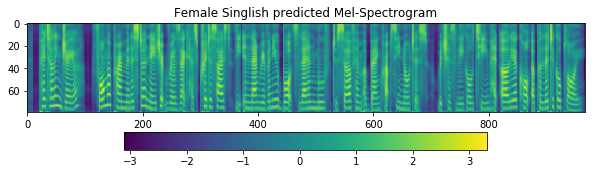
[23]:
fig = plt.figure(figsize=(10, 8))
ax1 = fig.add_subplot(311)
ax1.set_title('Female Singlish predicted Mel-Spectrogram')
im = ax1.imshow(np.rot90(r_fastspeech['mel-output']), aspect='auto', interpolation='none')
fig.colorbar(mappable=im, shrink=0.65, orientation='horizontal', ax=ax1)
plt.show()
Predict GlowTTS
def predict(
    self,
    string,
    temperature: float = 0.3333,
    length_ratio: float = 1.0,
    **kwargs,
):
    """
    Change string to Mel.

    Parameters
    ----------
    string: str
    temperature: float, optional (default=0.3333)
        Decoder model trying to decode with encoder(text) + random.normal() * temperature.
    length_ratio: float, optional (default=1.0)
        Increase this variable will increase time voice generated.

    Returns
    -------
    result: Dict[string, ids, mel-output, alignment, universal-output]
    """
It only able to predict 1 text for single feed-forward.
[10]:
%%time

r_glowtts = glowtts.predict(string1)
CPU times: user 607 ms, sys: 55.1 ms, total: 662 ms
Wall time: 133 ms
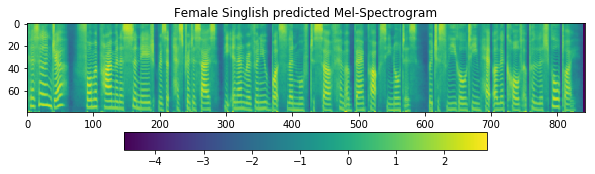
[11]:
fig = plt.figure(figsize=(10, 8))
ax1 = fig.add_subplot(311)
ax1.set_title('Female Singlish predicted Mel-Spectrogram')
im = ax1.imshow(np.rot90(r_glowtts['mel-output']), aspect='auto', interpolation='none')
fig.colorbar(mappable=im, shrink=0.65, orientation='horizontal', ax=ax1)
plt.show()
Load Vocoder model
There is only 1 way to synthesize melspectrogram output from Singlish TTS models,
If you are going to use universal MelGAN, use
universal-outputfrom TTS model. Read more at https://malaya-speech.readthedocs.io/en/latest/load-universal-melgan.html
[12]:
vocoder = malaya_speech.vocoder.melgan(model = 'universal-1024')
[25]:
y_ = vocoder(r['universal-output'])
ipd.Audio(y_, rate = 22050)
[25]:
[26]:
y_ = vocoder(quantized_r['universal-output'])
ipd.Audio(y_, rate = 22050)
[26]:
[27]:
y_ = vocoder(r_fastspeech['universal-output'])
ipd.Audio(y_, rate = 22050)
[27]:
[13]:
y_ = vocoder(r_glowtts['universal-output'])
ipd.Audio(y_, rate = 22050)
[13]:
Predict Bahasa text
[28]:
string = 'husein zolkepli sangatlah comel, ketiak wangi dan mempunyai baby yang comel. Husein juga suka mandi pada waktu pagi dan petang sambil menggunakan sabun lifeboy.'
[29]:
%%time

r = tacotron.predict(string)
CPU times: user 5.16 s, sys: 164 ms, total: 5.32 s
Wall time: 4.58 s
[30]:
%%time

quantized_r = quantized_tacotron.predict(string)
CPU times: user 3.09 s, sys: 129 ms, total: 3.22 s
Wall time: 2.66 s
[31]:
%%time

r_fastspeech = fastspeech.predict(string)
CPU times: user 1.1 s, sys: 85.6 ms, total: 1.19 s
Wall time: 193 ms
[32]:
y_ = vocoder(r['universal-output'])
ipd.Audio(y_, rate = 22050)
[32]:
[33]:
y_ = vocoder(quantized_r['universal-output'])
ipd.Audio(y_, rate = 22050)
[33]:
[34]:
y_ = vocoder(r_fastspeech['universal-output'])
ipd.Audio(y_, rate = 22050)
[34]: